




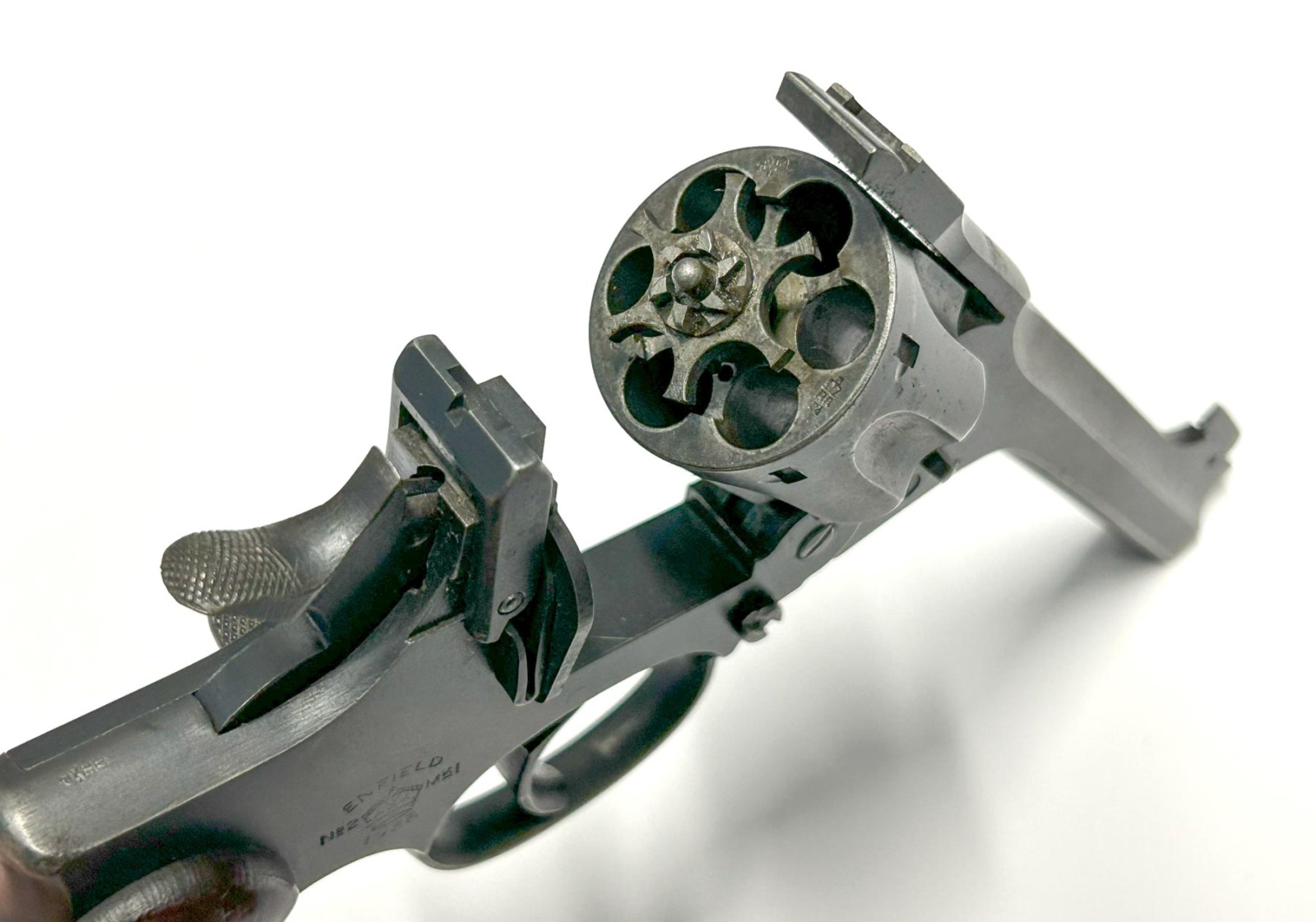
The Royal Small Arms Factory at Enfield in the UK was responsible for at least three British service revolvers, including the Enfield No 2 Mk I. But did you know Australia also manufactured that revolver?
During WWII, when Australia was facing the threat of invasion by the Japanese, our defence industry was desperate for any arms it could get. While the Small Arms Factory at Lithgow was cranking out SMLE rifles, Bren guns and Vickers guns, and Lysaght was making the Owen SMG, a local manufacturer was enlisted to manufacture revolvers — with mixed results, as it turns out.

After WWI, the British military realised that the large-calibre, top-break .455 Webley Mk VI revolver might be overdoing things a bit, and it was quite hard to teach new recruits to shoot effectively with it.
Following extensive testing in the 1920s, they decided a .38-calibre handgun with a heavy projectile (200gn) would be just as effective as a .455 yet would be easier to handle.
The cartridge the British adopted — .380” Revolver Mk I — was essentially a .38 S&W round with a 200gn LRN projectile (known commercially in the US as .38 Super Police) instead of the standard 145gn LRN bullet. Shortly before WWII, the Mk II round was introduced, using a 178gn FMJ projectile.
The reasons they did not go with a .38 Special cartridge, which had been around for at least 25 years by this point, have never been adequately explained.

English gunmaking firm Webley & Scott had been the de facto supplier of British military service pistols ever since the military adopted the .455 calibre Webley Mk I revolver in 1887. It was already producing a civilian handgun (The Webley Mk IV) that was essentially a scaled-down .455 Webley Mk VI revolver in the .38 S&W cartridge anyway. So W&S promptly entered it in the tender for the new service pistol and waited for the telegram confirming its adoption, followed by a hefty cheque.
Neither of those things happened.
In June 1932, the British military adopted the Enfield No 2 Mk I and it was immediately obvious to anyone with a functioning set of eyes that Royal Small Arms Factory Enfield had more or less reverse-engineered the Webley Mk IV, changed a few minor things (some of which were admittedly improvements) so it didn’t look like they’d copied Webley’s homework, then put the design into production.
To say Webley & Scott was unimpressed would be an understatement, and they immediately sent a bill to the government for £2247 (about $1 million today) relating to the development costs of the Webley revolver design submitted to the tender process.
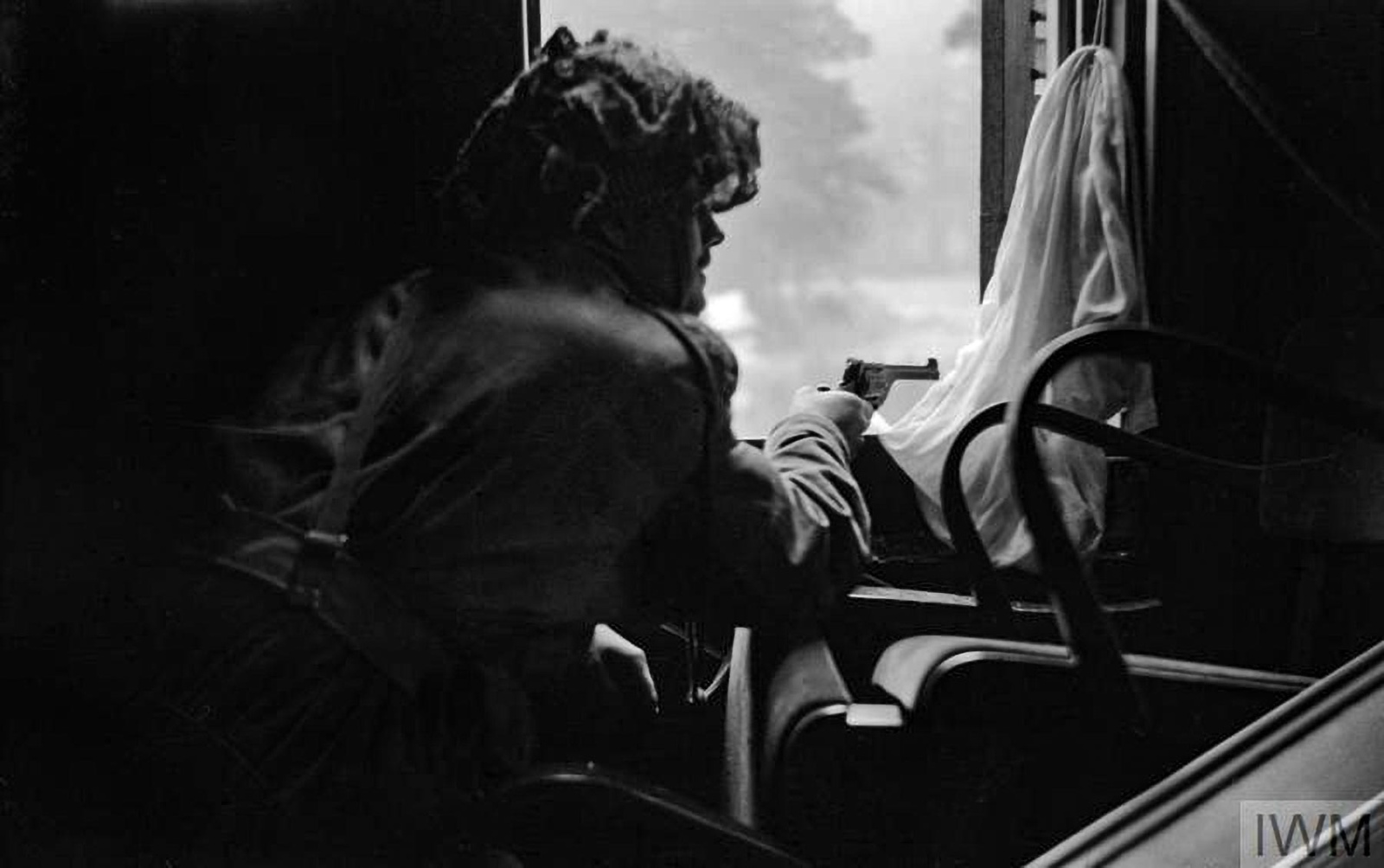
Rather than admitting to (at a minimum) taking significant inspiration from the Webley design, RSAF Enfield told Webley the Enfield No 2 Mk I revolver had actually been designed by Captain Henry C Boys (after whom the Boys anti-tank rifle was later named) with assistance from Webley & Scott, and not the other way around — and so no, they wouldn’t be paying Webley & Scott for the alleged costs of developing the Mk Webley IV revolver.
Webley & Scott was furious and evidently made some calls, and in 1929 they received £1200 (about $575,000 today) from the Royal Commission on Awards to Inventors, which was a Royal Commission set up to provide compensation to inventors whose products had been used in WWI — in particular, the various people who all claimed they’d invented the tank.
Despite missing out on the contract, and arguably having their design stolen, Webley & Scott decided to keep producing the Mk IV revolver as a commercial product for civilian sales and “private purchase” to officers, since it used the now-standard .380 Revolver cartridge. It proved extremely popular and ended up seeing service in WWII alongside the Enfield design.
Around 1938, it was decided to modify the Enfield No 2 Mk I design and remove the hammer spur, turning the gun into a double-action-only (DAO) design, designated Pistol No 2 Mk I*.
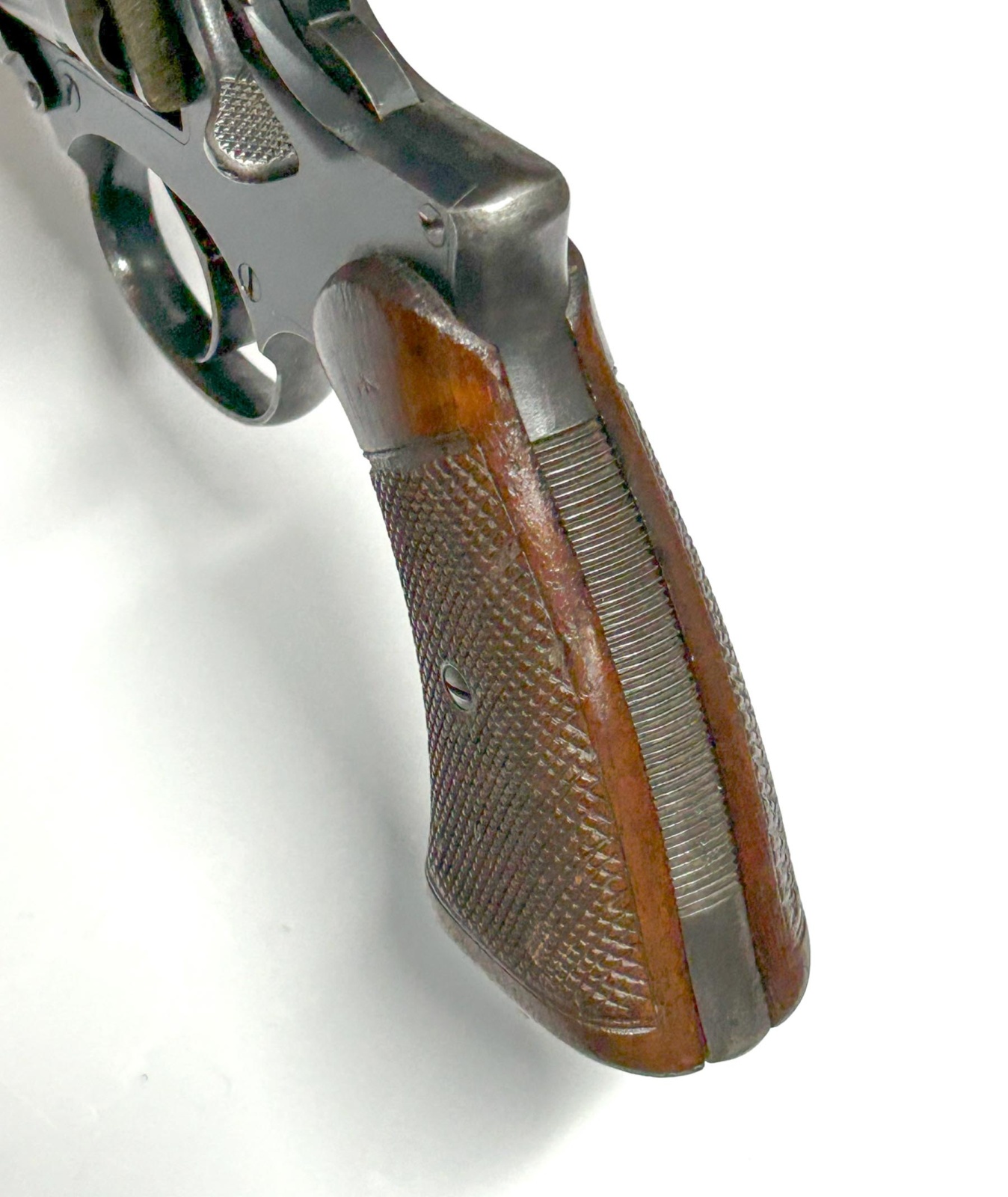
New grips, made of Bakelite and featuring a thumb-groove, were also developed. These grips contained a brass disc, intended for the stamping of unit ownership markings (as found on some early SMLE rifles), but it does not seem the discs were so marked in any notable quantities.
Officially, the design change was because the Royal Tank Regiment apparently complained the hammer spur caught on things inside the tanks, owing to the open holsters the crews wore.
Realistically, however, the change to the Mk I* configuration is more likely to have been because it was easier and cheaper to make, requiring less fitting and tooling than the double-action version — especially when you consider that the butt of the revolver, rather than the hammer-spur, was far more likely to be catching on things inside a tank or armoured car.
As WWII became more desperate, a Mk I** version was developed, incorporating further production efficiency measures, including removing the hammer safety stop – which meant the pistol could go off if it was dropped (as happened with a S&W Victory revolver in 1944). Fortunately, these changes were quickly binned, and the Mk I* remained the standard model throughout WWII.
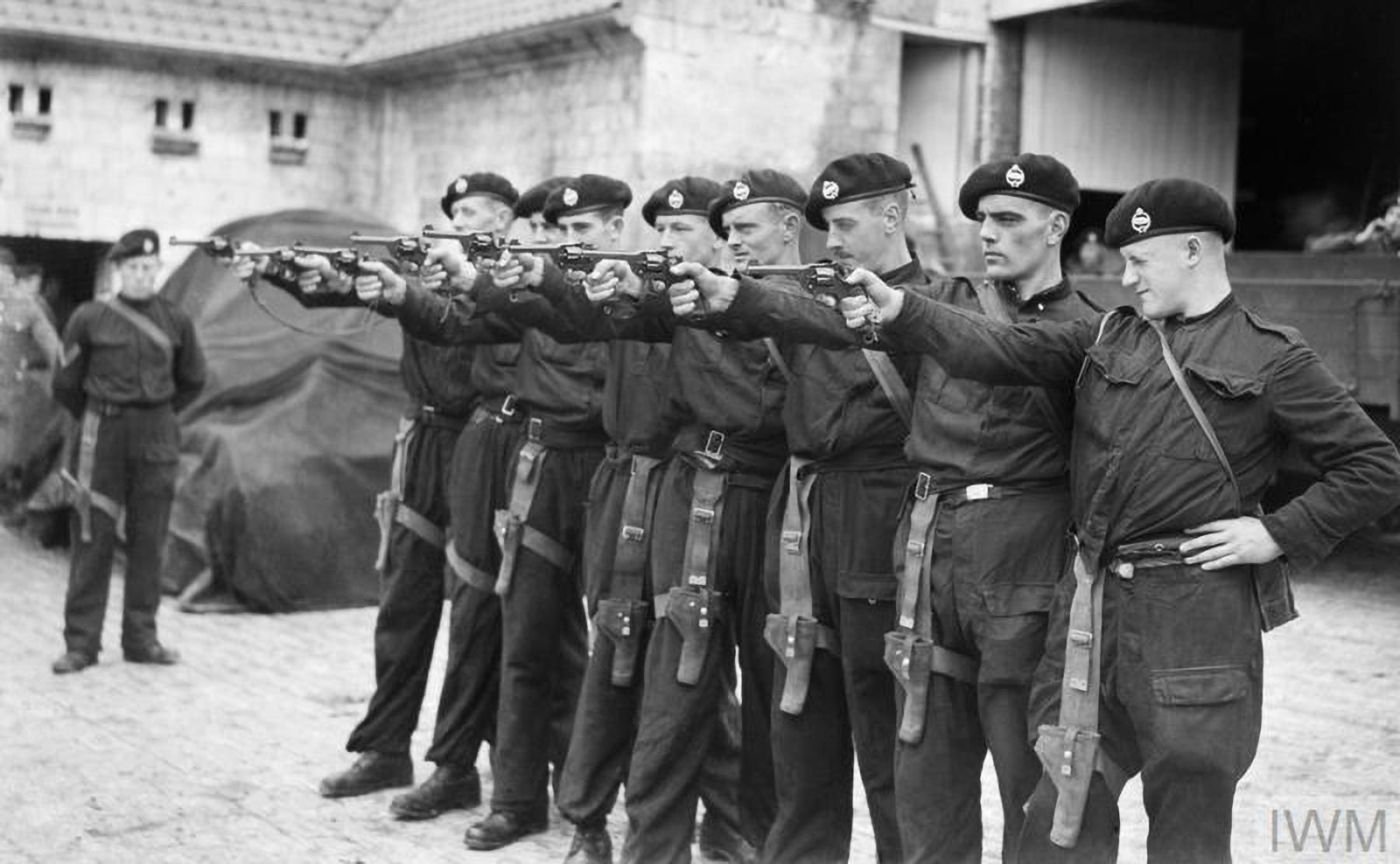
Made in Australia (and elsewhere in the UK)
In 1941, it was decided Australia should be making its own service pistols as well. The contract was awarded to the Howard Auto Cultivator company (HAC) in Sydney to produce the No 2 Mk I*, which by then the Australian military standard-issue service revolver, at its factory in Northmead.
Production began in 1942, but HAC may have been a bit optimistic about its revolver-making potential, and by 1945 only about 355 HAC Enfield revolvers had been produced — an average of less than two revolvers per week.
Serial number information suggests as many as 420 may have been manufactured, with the difference not being accepted for service and scrapped for parts/metal.
HAC managed to produce 11 revolvers in 1941-1942, 274 in the 1942-1943 financial year, and 70 between mid-1943 and the end of the war, with production mostly ceasing by 1944.
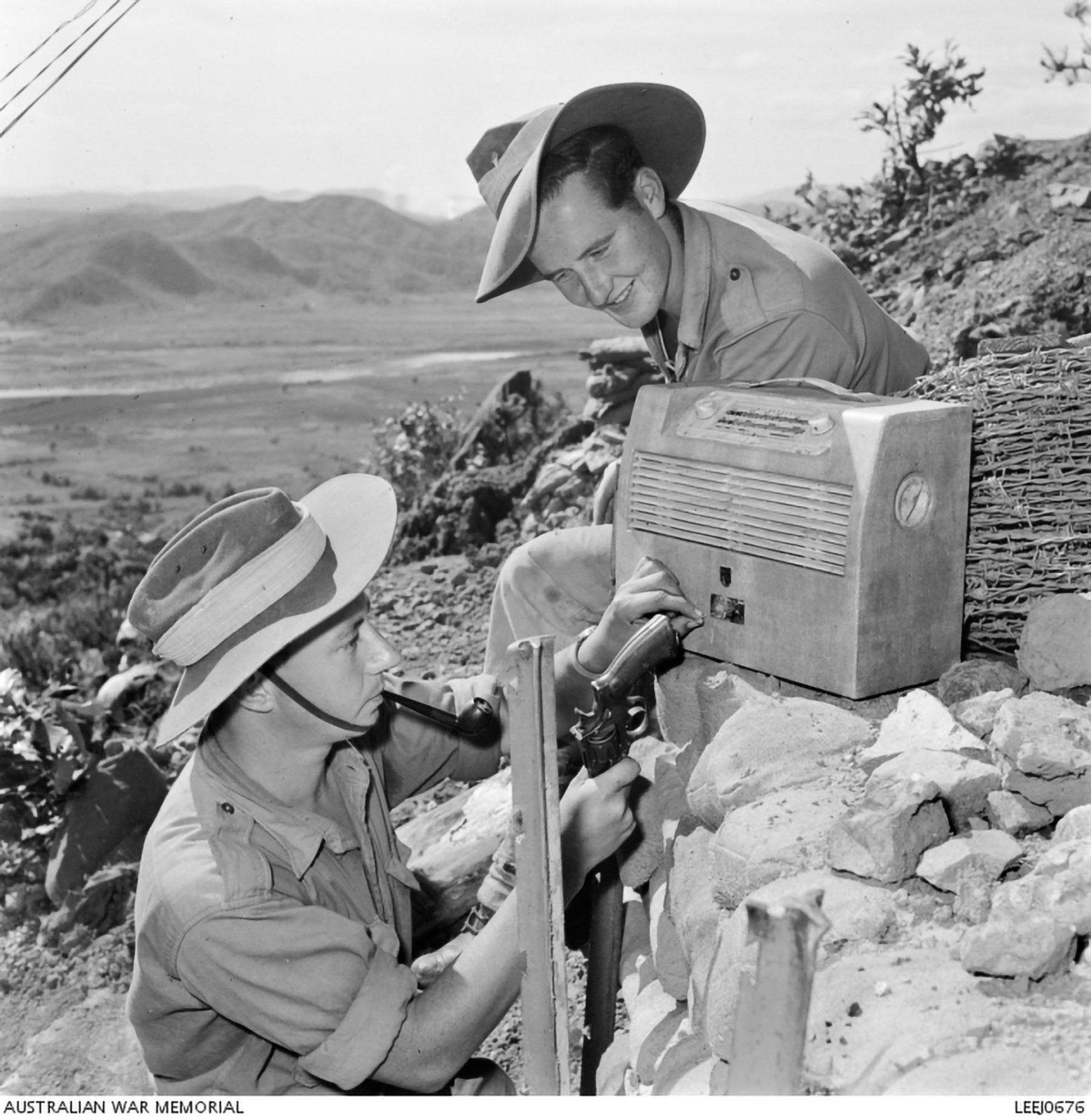
An unknown (but likely small) number are also reported to have headed out the door in factory worker lunchboxes, or been assembled after the war by people using parts either salvaged from the factory’s dumping area or improperly accounted for during the war.
One of the key issues facing the revolvers was their lack of interchangeability. Many of the HAC guns reportedly worked just fine as manufactured, but if disassembled, mixed with parts from other HAC No 2 Mk I* revolvers, then reassembled, they would not function correctly.
According to a 1959 recollection by Howard Industries managing director John O’Brien, the interchangeability issue was at least partly due to “the non-availability from government sources of the necessary toolage and machine tools”.
The project also suffered from competing priorities. Parts for Owen guns and Austens were considered more vital to the war effort (and by all accounts, the HAC components for these guns were well made and functioned exactly as required).

Manufacturing a revolver was an afterthought, given the manpower and resource shortages at the time, although Mr O’Brien did acknowledge HAC had not handled the project well, either.
Despite it seeming apparent that Australian mass-manufacturing of the No 2 Mk I* revolvers was not feasible fairly early in the proceedings, it appears the project was continued partly due to sunk costs (the project was estimated to have cost the Australian government the equivalent of about $250,000 today), and also because the Australian military had lots of .380 Mk IIz ammunition available.
At one point in 1943 Hastings Deering, another agricultural machinery manufacturer, tried to complete the revolvers so HAC could focus on SMG parts. It had limited success.
By the end of the war the Australian government had been convinced to abandon the project as part of the country’s workforce transition back to peacetime operations.

Mr O’Brien noted the No 2 Mk I* revolver had been designed well over a decade earlier and “was quite unsuitable for manufacture on an assembly line basis”.
He speculated any existing design or technical drawings for the gun “were practically useless for modern manufacturing methods, particularly the dimensioning and tolerances”.
He even went so far as to say the SMLE would have had the same issue if it was being made by a commercial enterprise instead of the government-owned Small Arms Factory at Lithgow.
Back in the UK, it turned out RSAF Enfield was also having trouble meeting production quotas for the No 2 Mk I* revolver — a significant problem given the incredible need for handguns by the British military at the time.
In 1941, production began at Albion Motors in Scotland. Albion produced 21,422 revolvers until 1943, when production was shifted to Coventry Tool & Die Company, which made another 21,094 (still stamped “Albion”).
Webley & Scott ended up having its revenge during this time as well. With a war on, the British government was forced to buy large numbers of the Webley Mk IV revolver, which proved to be more popular with users than the No 2 Mk I* on account of the Webley’s ability to be fired single-action if needed.
General production of the Enfield No 2 Mk I* revolver ended in 1945, with the design officially being declared obsolete in 1954.
However, a production run of 6000 was undertaken for Pakistan in 1956-57, and the revolvers remained in British and Australian service well into the 1960s before they were finally replaced with the Browning Hi-Power.
Numbers of Enfield revolvers ended up in Britain’s overseas colonies from the 1950s onwards and it is quite possible some are still in limited use as police or reserve firearms in some remote places.
Interestingly, despite the Mk I* configuration being the official standard from the late 1930s onwards, significant numbers of revolvers in the original Mk I configuration, with hammer-spur and single-action firing ability, can still be found today.
It is thought these were largely RAF, Military Police or Royal Navy issue guns that saw little use and subsequently never needed to be returned to armouries for overhaul, subsequently avoiding conversion to the Mk I* configuration.
Just over 300,000 Enfield No 2 revolvers were manufactured between 1932 and 1945, the large majority at RSAF Enfield.
Of the 355 known HAC revolvers, only a fraction survive today, some in Australia and a handful overseas, the others having fallen victim to time and firearms law changes in Australia.
Interestingly, at least one Enfield No 2 Mk I* revolver was produced unofficially by a small-scale workshop in Vietnam at some point during either the French-Indochina War (1946-1954) or the Vietnam War; it has “Cong-An Xuon” and “Saigon” stamped on the right-hand side along with a logo featuring the intertwined letters “C” and “A” surrounded by laurels, and “Made in Vietnam” on the frame underneath the cylinder.
The definitive text on the Enfield No 2 Mk I revolver is Mark Stamps and Ian Skennerton’s .380 Enfield No 2 Revolver. It has been out of print for some years but second-hand copies still surface with some regularity.
SHOOTING THE ENFIELD NO 2 MK I REVOLVER
The Enfield No 2 Mk I handles, operates and shoots identically to the Webley Mk IV, although it does have a lighter trigger pull, coming in at 15lb (6.8kg) in double-action and 5lb (2.2kg) in single-action, against the Webley’s 17lb (7.7kg) double-action pull and 8.5lb (4kg) single-action pull.
The Enfield No 2 Mk I* has a slightly lighter double-action pull again, at around 12lb (5.4kg).
Maintenance is slightly easier on the Enfield, thanks to its removable side-plate, and like the Webley, it can also be reloaded with speedloaders designed for S&W K-frame revolvers.
For obvious reasons the No 2 Mk I configuration is more desirable for shooters in Australia, although the Mk I* can certainly still be used for the same competitions if the shooter is willing to deal with the double-action only operation.
The Enfield No 2 revolver is an interesting companion piece to the better-known Webley revolvers, and is also the last revolver adopted for general issue by the British military, giving it an important place in firearms history as well as collections and gun cabinets.
SPECIFICATIONS
Calibre: .380 Revolver (.38 S&W)
Action: Revolver
Cylinder: 6 rounds
Barrel Length: 5in (127mm)
Overall Length: 10.25in(260mm)
Weight: 1.7lb (765gm)


0 Comments